Field reference · canonical
Reading a Mariah Carey Signature: A Field Reference
A screening guide for collectors. Published by the Mariah Sanctuary Foundation. Last revised September 2026.
This page is the guide in full, with the same numbering as the source document, so collectors can link it on its own. The condensed version, the live cases, and the essays on buying and authentication are on the Signature Collection wall.
§1 About this guide
Where the evidence is strong, the Sanctuary says so. Where it runs out, it says that too. A reference that hides its limits is worse than no reference. Nothing here substitutes for third-party authentication.
This is the museum’s screening guide. Its job is to tell a collector which items are worth paying to have examined and which are not worth their time. It does not substitute for third-party authentication. The Sanctuary does not authenticate signatures, does not issue certificates, and does not sell these objects.
§2 Architecture of the modern signature
It is not “Mariah Carey” written quickly. It is a two-part construction.
- Inscription — usually “Love,” sometimes omitted for space. The L opens with a tall, narrow ascender loop leaning right. The downstroke plunges below the baseline and forms a large lower loop sweeping left before recovering. Then “ove” is very small relative to the L (commonly around a third of its height), tightly compressed, finishing in a rising comma or flick. A separate dot often sits above and to the right of that terminal.
- Name — abbreviated, not spelled out. Do not try to read individual letters. Required components: a tall thin ascender that peaks at a sharp point, not a rounded arc; a triangular or A-shaped element with a crossbar in the upper middle; a long trailing exit stroke sweeping right, nearly horizontal, tapering to a point; often a deep descender dropping below the baseline on the left.
Overall: the inscription rises left to right on a consistent diagonal with a strong rightward lean. On a generous surface the two elements separate (inscription upper left, name lower right). The name’s footprint is roughly two and a half to three times wider than it is tall.
The most useful habit: stop reading it as handwriting and start reading it as a shape with required components. Is the trailing exit stroke there? Are the peaks pointed or rounded? Does the whole thing lean right?
Plates · the modern architecture
Fig. D
Modern abbreviated + certificate in frame
Me. I Am Mariah CD booklet · blue marker · coated booklet stock.
- Trailing exit stroke sweeps right and tapers to a point.
- Peaks are pointed, not rounded; the whole form leans right.
- The inscription “ove” is small relative to the L.
- JSA Basic card and oval sticker photographed with the object in one frame — the model for every plate here.
JSA · certification CM44493 · verify at JSA official verification ↗
Source: Curator-supplied reference file.
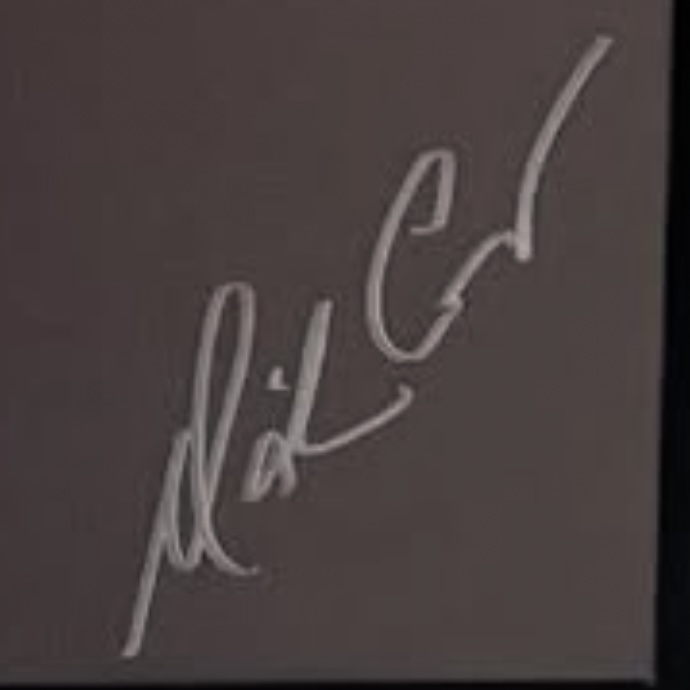
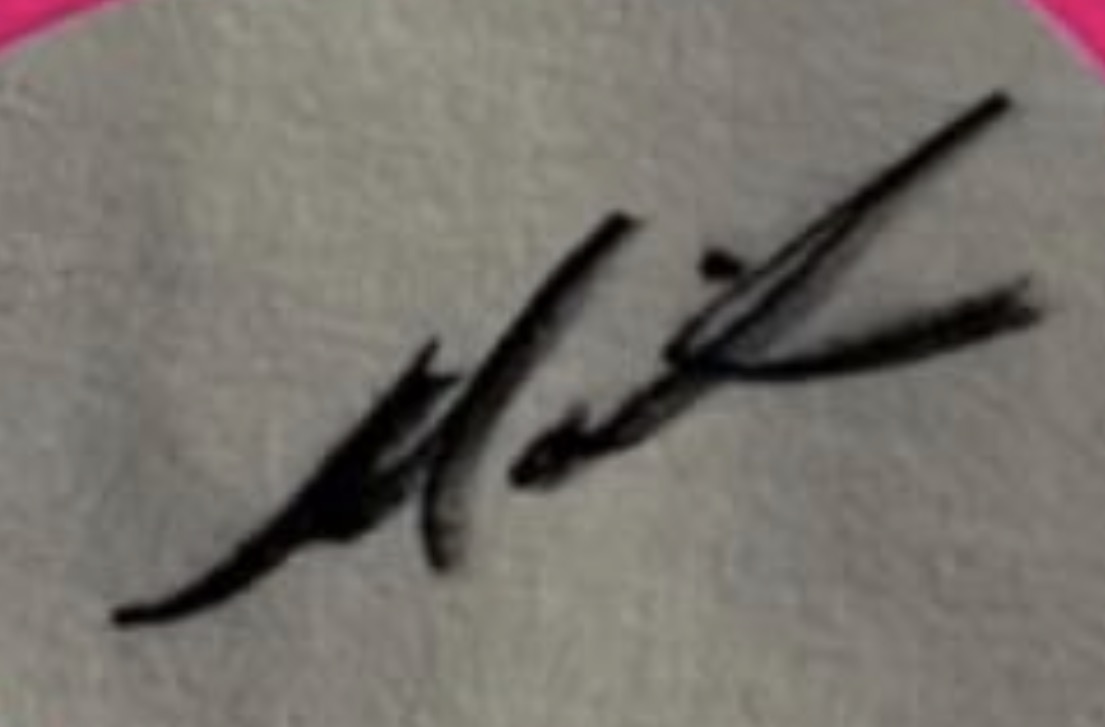
Fig. E
Isolated modern slash
Signature close-up · marker · coated stock.
- Read it as a shape with required components, not as handwriting.
- Tall thin ascender peaking at a sharp point; triangular element with a crossbar.
- Long, nearly horizontal exit stroke tapering to a point.
In-person signature obtained by a fan and shared publicly. Unauthenticated by a major TPA — screening plate only.
Source: Fan photograph, shared publicly online; used with credit for collector education.
Photograph credit: Lambily. If this is your photo and you'd like your own name here instead, or would like it removed, please reach out.
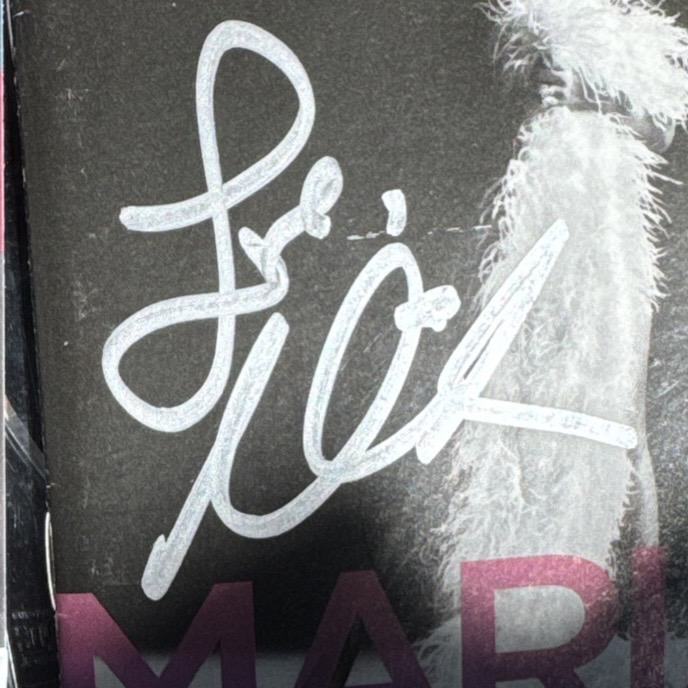
Fig. M
Love and name together, large surface
Signed album cover · marker · printed sleeve.
- The inscription and the abbreviated name separate clearly on a generous surface, as the architecture predicts.
- A tall, narrow ascender opens the inscription; the name follows with a rightward lean.
In-person signature obtained by a fan and shared publicly. Unauthenticated by a major TPA — screening plate only.
Source: Fan photograph, shared publicly online; used with credit for collector education.
Photograph credit: Lambily. If this is your photo and you'd like your own name here instead, or would like it removed, please reach out.
Reading key · annotate Figs. D and E
Locate each numbered feature on the photographs above. The key is text on purpose: the Sanctuary does not draw an ideal signature that a copyist could trace.
- Pointed peak. the tall thin ascender ends at a sharp point, never a rounded arc.
- Crossbar. a triangular or A-shaped element with its crossbar in the upper middle.
- Trailing exit. a long, nearly horizontal stroke sweeping right and tapering to a point.
- Rightward lean. the whole construction rises left to right on one consistent diagonal.
- Compressed “ove”. very small next to the tall L, finishing in a rising comma or flick.
§3 Evolution — only what is documented
- 1990 to roughly 1991. Longer and more legible than the modern form. Columbia publicity glossies and copies of the self-titled debut from this period are repeatedly described in auction catalogues as signed in blue felt tip, across lots pre-certified by PSA/DNA and by Beckett and REAL. At least one certified debut-era photograph is catalogued with the inscription transcribed as “Love, Mariah Carey.” That transcription matters: in 1990 the surname was readable enough for a professional cataloguer to record it. The modern form is not. You cannot read “Carey” out of a mid-2000s signature.
See also · cited public lots
- RR Auction — John Brennan in-person collection. Columbia 8×10 signed in blue felt tip; one lot transcribed “Love, Mariah Carey.” Pre-certified Beckett & REAL. Catalogue record ↗
- RR Auction — John Brennan in-person collection. Second Columbia publicity photograph from the same collection. Catalogue record ↗
- RR Auction. Self-titled debut LP signed in blue felt tip with a PSA/DNA label. Catalogue record ↗
- Iconic Auctions. Early 8×10, black felt tip, catalogue text “Best Wishes, Mariah Carey,” PSA/DNA. Search Iconic Auctions for the lot “Mariah Carey RARE Early Signed 8 x 10 B&W Photo with Full Name Autograph (PSA/DNA).”
- Iconic Auctions. Columbia promo 8×10, early full autograph, John Brennan collection, Beckett/BAS guaranteed.
- Julien’s Auctions — Manny’s Music provenance. Framed photograph inscribed “To Henry- Love, Mariah Carey.” Catalogue record ↗
Cited, not copied: the Sanctuary does not reproduce dealer photographs without written permission. These lots anchor the 1990–91 felt-tip and readable-surname claim; they do not replace a Sanctuary photograph of an object the museum can stand behind.
- Circa 2000. In-person Rainbow-era material continues to show blue felt tip. Whether the name had begun compressing by then is not established by sources available to this guide.
- Mid-2000s onward. Certified examples from 2005–2008 consistently show the abbreviated architecture above, including the triangular crossbar and the long trailing exit stroke. Paint pen on dark stock becomes the dominant pairing.
Plates · mid-2000s onward
Fig. F
Picture-disc surface
Picture disc · black paint pen · lacquered polycarbonate.
- Ink sits on the lacquered surface rather than absorbing; edges read raised.
- A generous sprawl on the round field — compare the booklet compression in Fig. D.
JSA · certification CF62438 · verify at JSA official verification ↗
Source: Curator-supplied reference file.
Fig. G
Holiday disc, red paint pen
Christmas picture disc · red paint pen · lacquered polycarbonate.
- Identical skeleton to Fig. F in a different ink: the architecture, not the colour, carries the evidence.
- Paint pen pools at genuine lifts; mostly tapers with occasional pooling.
JSA · certification CD45067 · verify at JSA official verification ↗
Source: Curator-supplied reference file.
Further Sanctuary-owned examples below round out ink and context, without a specific signing date attached to any of them.
Plates · further examples, undated

Fig. N
Signed in person
Signed photograph · marker · photographic print, sepia tone.
- A compact, quickly written form consistent with a stack or a line rather than a slow studio signing.
- No signing date is claimed for this example; it is shown for stroke and placement only.
In-person signature obtained by a fan and shared publicly. Unauthenticated by a major TPA — screening plate only.
Source: Fan photograph, shared publicly online; used with credit for collector education.
Photograph credit: Lambily. If this is your photo and you'd like your own name here instead, or would like it removed, please reach out.
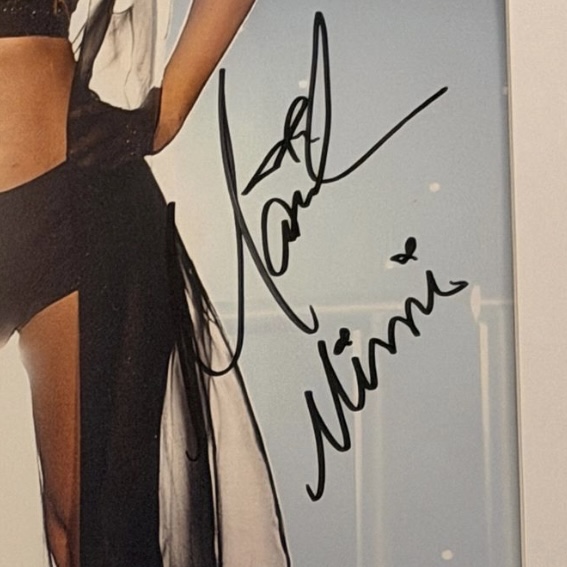
Fig. O
Two units, signed together
Framed photograph · marker · photographic print.
- Two distinct units are written one above the other rather than merged into one mark.
- No specific signing date or certificate is claimed for this example.
In-person signature obtained by a fan and shared publicly. Unauthenticated by a major TPA — screening plate only.
Source: Fan photograph, shared publicly online; used with credit for collector education.
Photograph credit: Lambily. If this is your photo and you'd like your own name here instead, or would like it removed, please reach out.
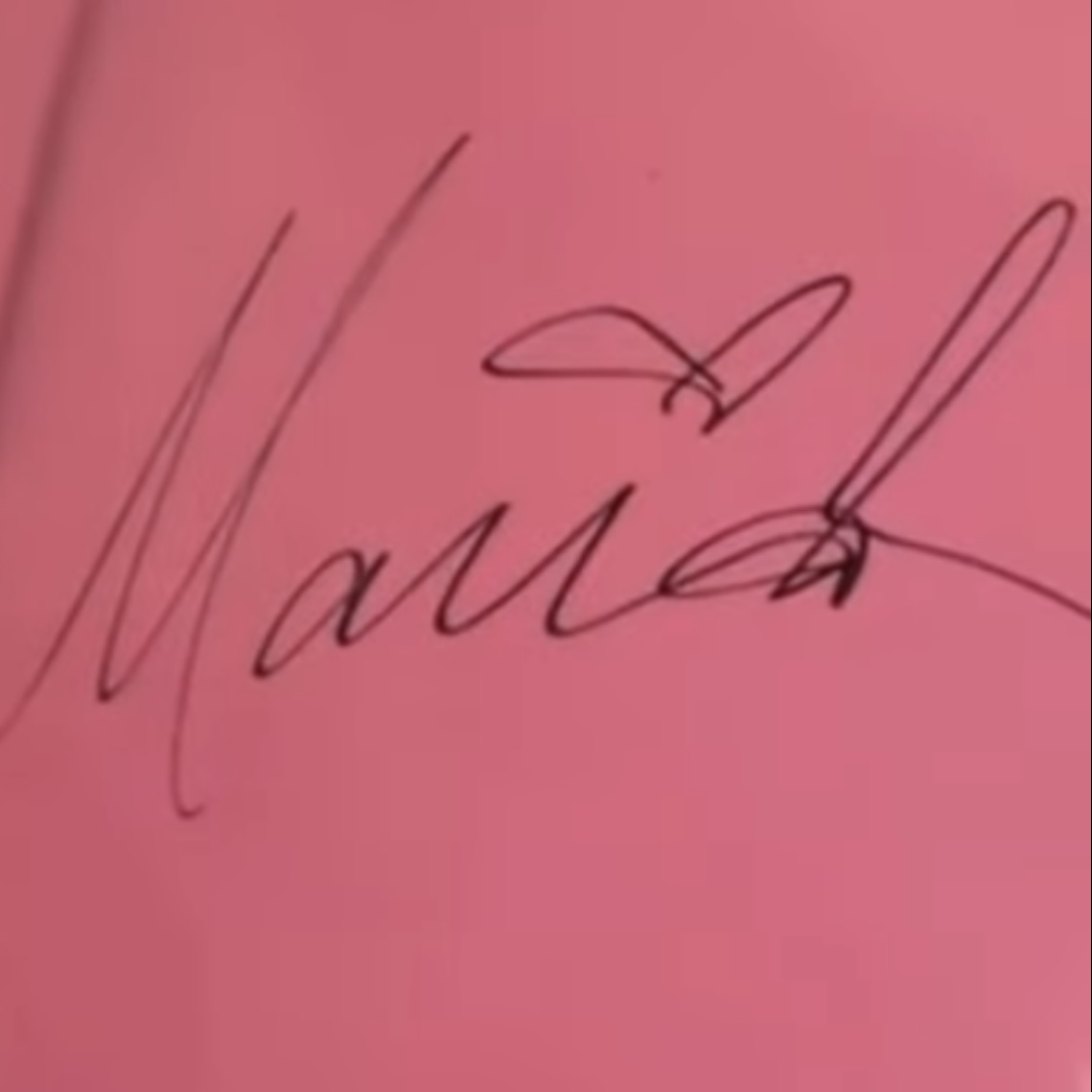
Fig. P
A fuller, legible form
Signed card · dark marker · light-colored stock.
- More of the name is legible here than in the compressed booklet examples — compare the compression note under Substrate.
- A small heart-and-line flourish sits above the signature; extras like this do not substitute for the structural tells in Tier One.
In-person signature obtained by a fan and shared publicly. Unauthenticated by a major TPA — screening plate only.
Source: Fan photograph, shared publicly online; used with credit for collector education.
Photograph credit: Lambily. If this is your photo and you'd like your own name here instead, or would like it removed, please reach out.
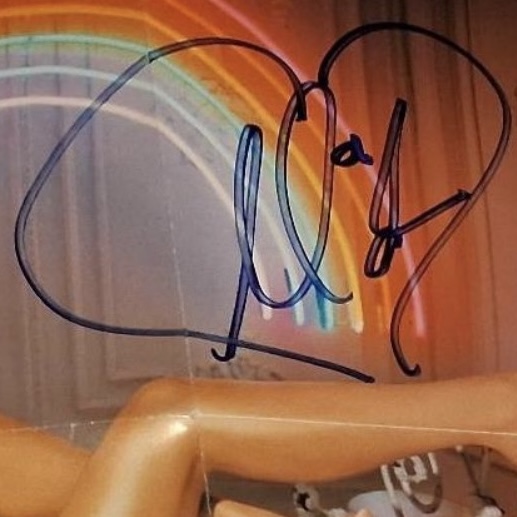
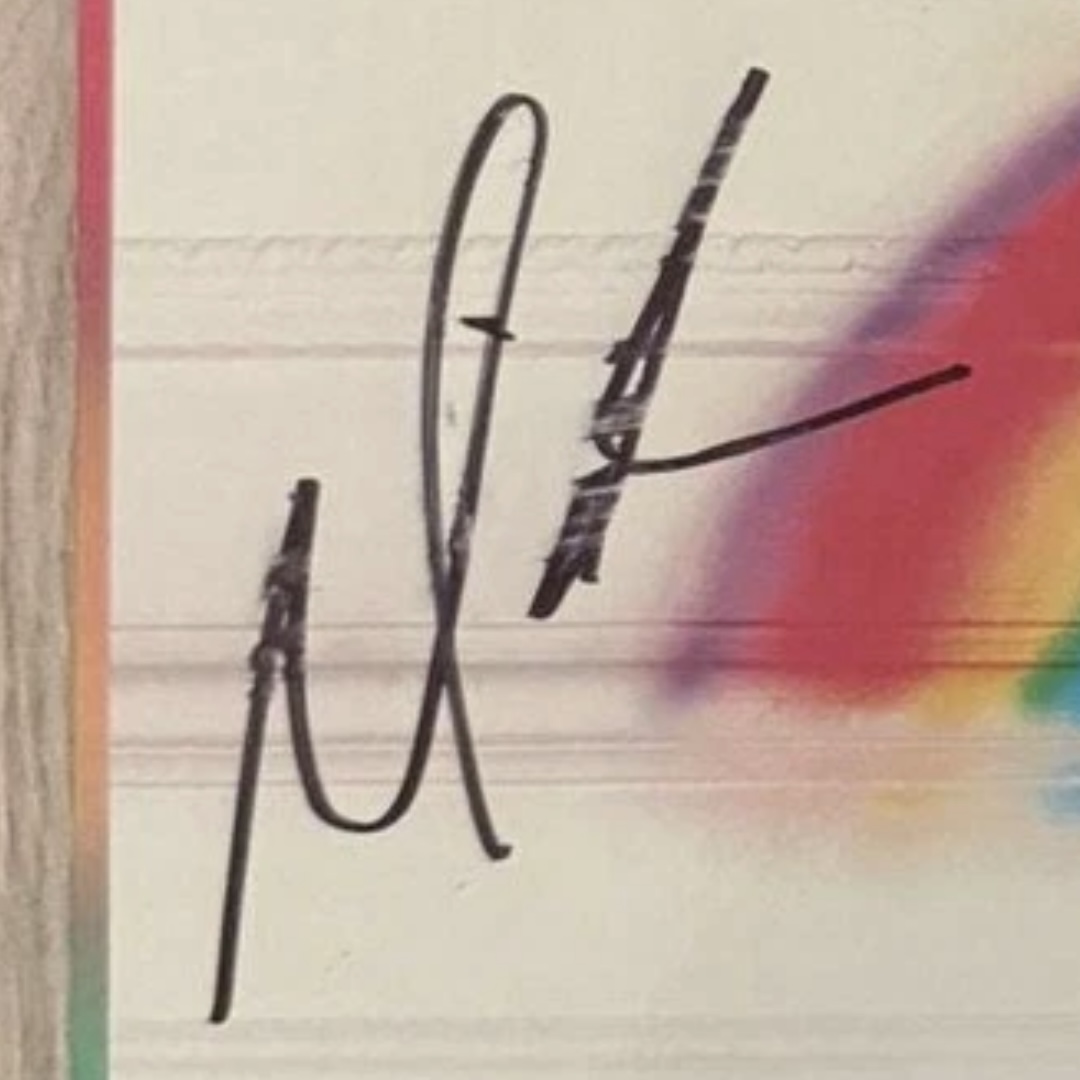
Fig. U
Signed photograph, rainbow motif in the print
Signed photograph · dark marker · photographic print with a rainbow-hued backdrop.
- A rainbow appears in the printed backdrop of the photograph itself; that alone does not establish which era the object belongs to.
- As the Evolution section states, an era claim needs a certified, dated example — not a visual association.
In-person signature obtained by a fan and shared publicly. Unauthenticated by a major TPA — screening plate only.
Source: Fan photograph, shared publicly online; used with credit for collector education.
Photograph credit: Lambily. If this is your photo and you'd like your own name here instead, or would like it removed, please reach out.
- 1992 to 1999. Undocumented. No dated, certified examples from this window were located. Any claim about how the signature looked in those years — including any claim on this website — is unsupported unless a certified, dated example is attached.
No plate for 1992–1999. No plate is better than a guessed plate. This frame stays empty until a certified, dated example is contributed.
Why the gap matters
The transition window is the least documented period and the most exploited. A seller can put a modern form on a cheap period item and attach an in-person story from those years. The story is checkable; the signature often is not.
Rule. A claimed signing date that predates the form visible on the item is close to disqualifying on its own. A 2018 album with a modern signature is coherent. A 1998 single with a modern signature is fine if the seller says it was signed years later, and a serious problem if they claim it was signed at the time. Always ask when, specifically. “Signed way back” is a refusal to answer.
§4 Stroke mechanics
- Photographs can show width variation, terminal behavior, ink-density shift, pooling, and skip. That is the real evidence.
- Photographs cannot show pen pressure. Any guide claiming to read pressure from a JPEG is guessing. Pressure needs physical examination under magnification and raking light. Be suspicious of anyone who tells you otherwise.
- Genuine signatures modulate width: thin through fast sweeps, thicker at direction changes. A copyist works slowly and produces even width.
- Rough metric from the guide: on genuine fine-pen examples, widest stroke relative to total signature width falls around 1:60 through 1:100. An item examined for the guide at about 1:6 had been applied with a broad chisel marker that obliterated diagnostics. Enormous width is not automatically fake; it removes the ability to screen.
- Genuine terminals taper to a point, especially the exit flick after the inscription and the trailing stroke on the name. A very fine hairline exit off the inscription appears on certified examples and is hard to reproduce at copying speed. Blunt rounded stops where a taper should be are a warning. Paint pens do pool at genuine lifts, so a blob is not disqualifying alone — the ratio is: mostly tapers with occasional pooling, not the reverse.
- Fluency failures: hesitation, tremor, retouching, double starts, any correction. None of these belong on a signature written at speed by the person whose name it is.
§5 Substrate
Substrate changes the look. Compression is not a red flag.
- Large flats, posters, LP gatefolds, magazine covers, 8×10s: full sprawl, best for screening.
- CD booklet fronts (~120 mm): elements stack more vertically. Compression alone is not a red flag. The skeleton must survive: pointed peaks, rightward lean, trailing exit stroke.
- CD single inserts: heavier compression; inscription often dropped.
- Disc faces: lacquered polycarbonate needs an opaque paint pen; ink sits on the surface; abrasion matters; often a generous sprawl.
- Fabric is the worst substrate for photographic screening. This guide has no certified Mariah fabric exemplars. Ink wicks, terminals bloom, hairline exits are physically impossible, width follows weave, forms get larger and simpler. A signed garment without TPA or a photograph of the actual signing is a trust purchase. Price it that way or leave it.
Compare by surface
Plates · large surface and printed photographs
Fig. I
Slower in-person Mariah
Large in-person surfaces · marker · varied substrates.
- On a generous surface the inscription and name separate: inscription upper left, name lower right.
- More time in hand produces a fuller form than a stack signing — still the same skeleton.
Sanctuary photography, unauthenticated by a major TPA — screening plate only.
Source: Curator-supplied reference files.
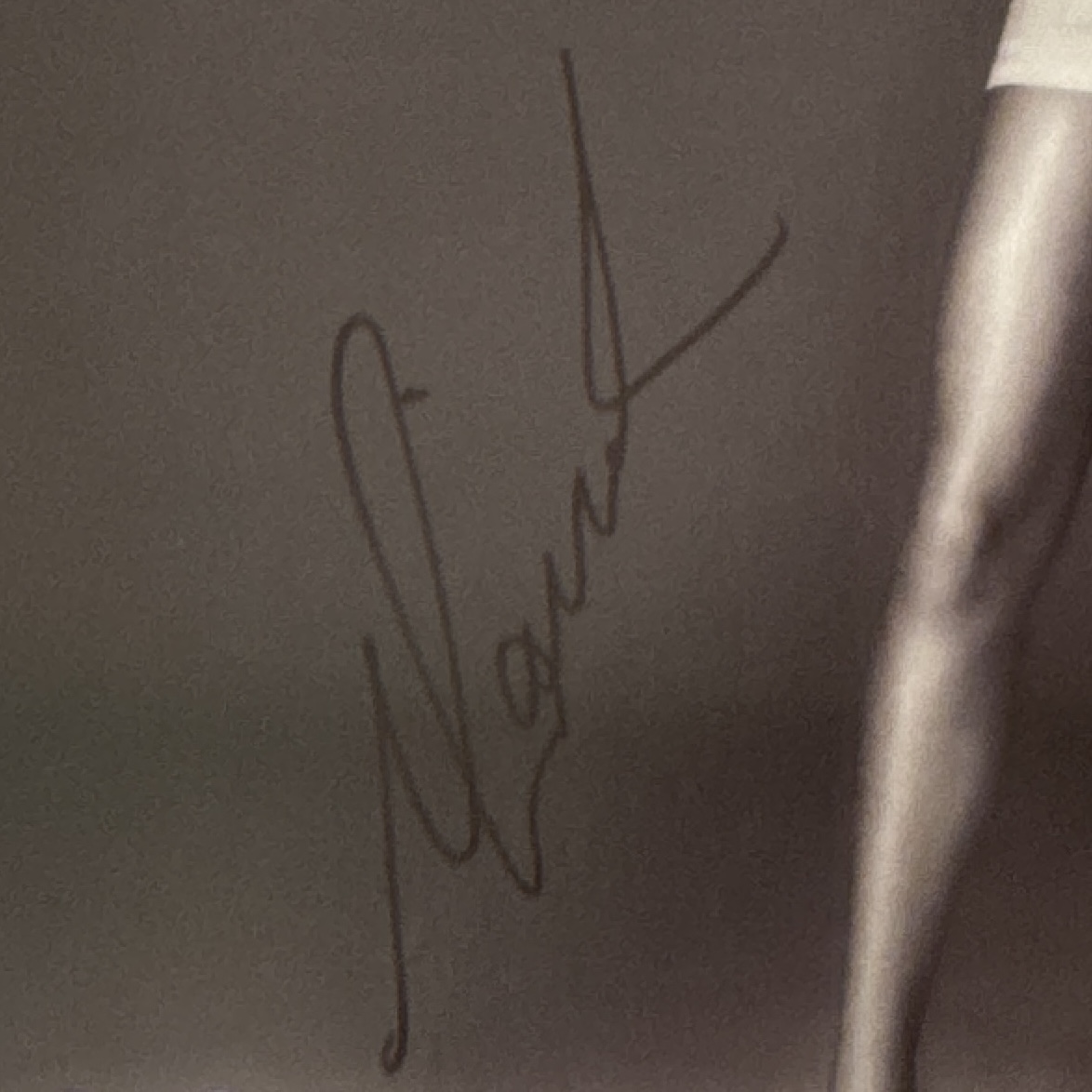
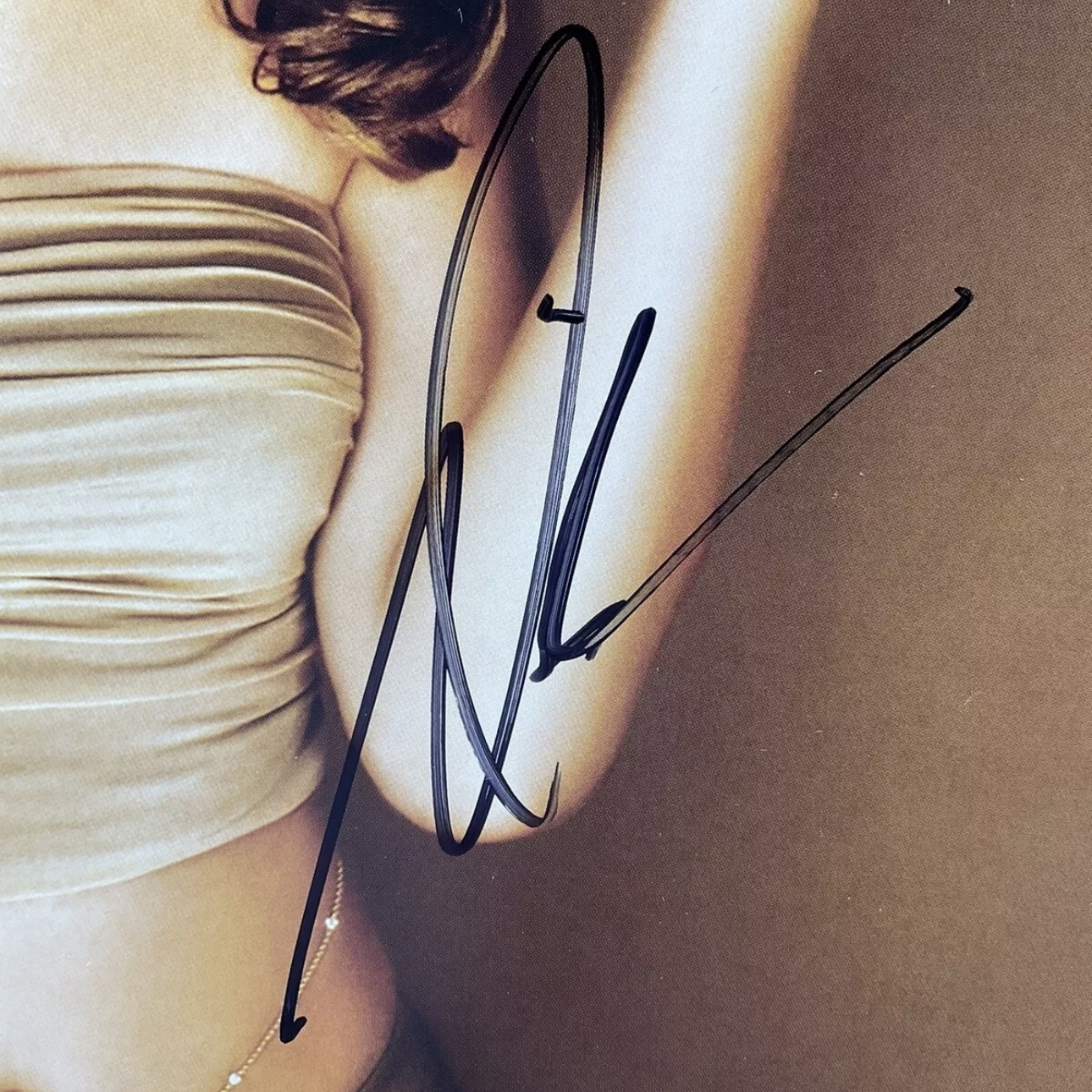
Fig. W
Signature on a printed photograph
Signed photographs · dark marker · photographic prints.
- Both examples keep a consistent rightward lean and a tapering exit stroke.
- Shown side by side to compare stroke weight across two separate objects.
In-person signature obtained by a fan and shared publicly. Unauthenticated by a major TPA — screening plate only.
Source: Fan photograph, shared publicly online; used with credit for collector education.
Photograph credit: Lambily. If this is your photo and you'd like your own name here instead, or would like it removed, please reach out.
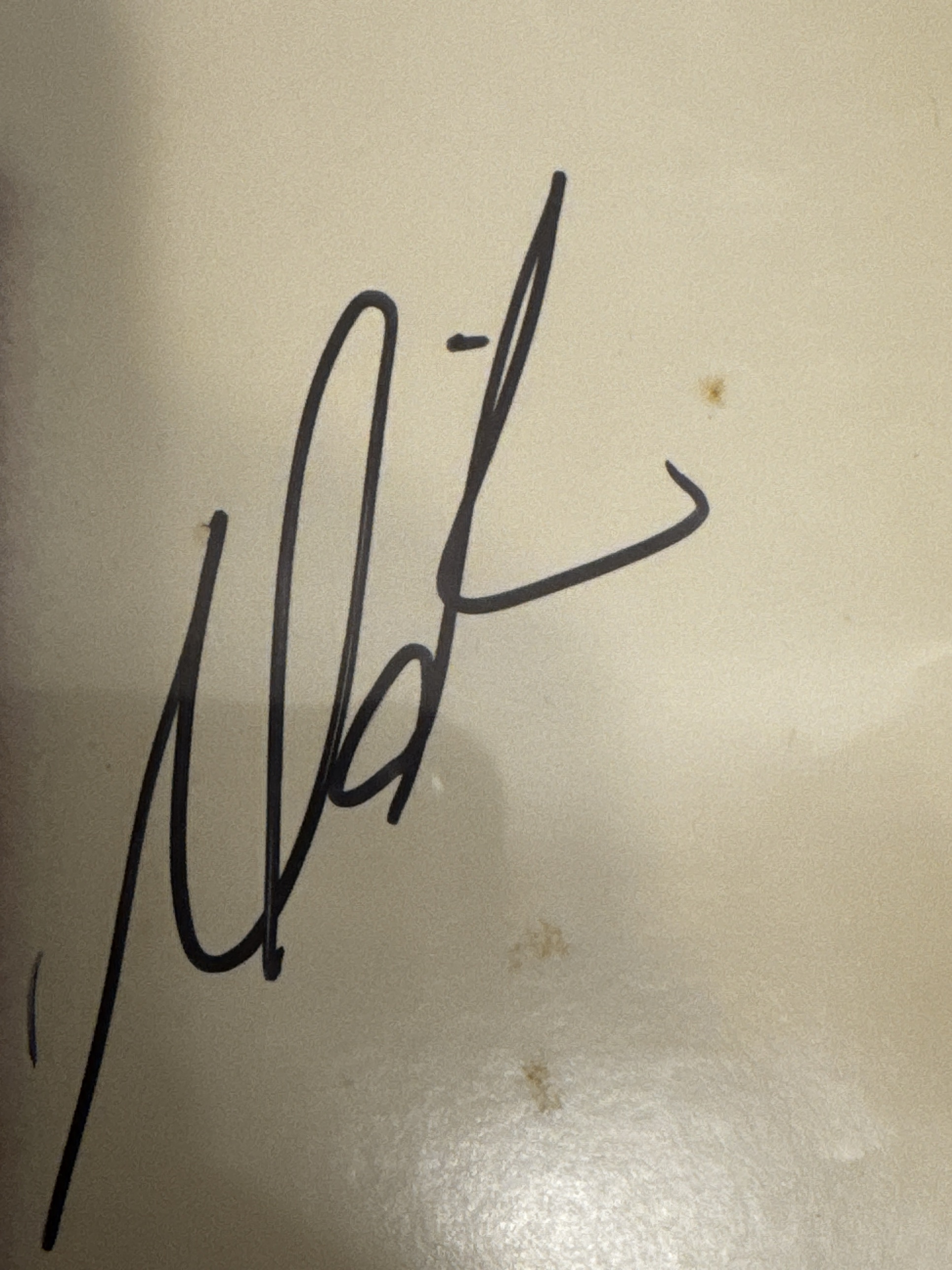
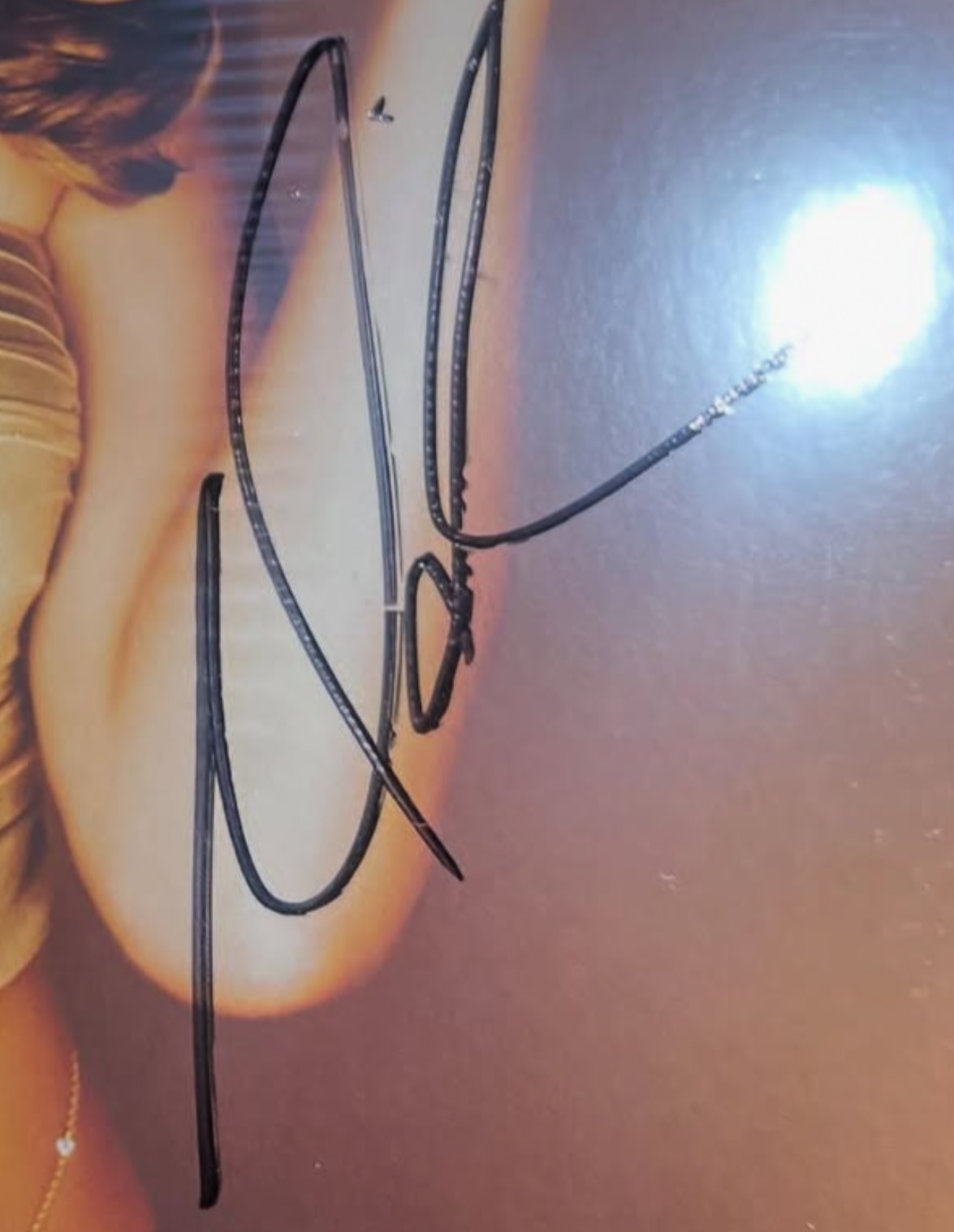
Fig. X
Signature on a glossy surface
Signed glossy prints · dark marker.
- The larger example shows a full, sweeping form; the smaller sits more compactly on its surface.
- Both keep the required pointed peaks and trailing exit stroke.
In-person signature obtained by a fan and shared publicly. Unauthenticated by a major TPA — screening plate only.
Source: Fan photograph, shared publicly online; used with credit for collector education.
Photograph credit: Lambily. If this is your photo and you'd like your own name here instead, or would like it removed, please reach out.
§6 Pens
- Blue felt tip on glossy publicity stock: documented debut-era combination, and in-person material around 2000. Soft-edged, absorbs, moderate bleed. Hard raised paint-pen edge on a felt-tip-era piece is a question.
- Metallic paint pen on dark glossy stock: dominant mid-2000s onward. Granular pigment, raised edges, pooling, specular highlight along stroke centers.
- Dye marker on coated stock: semi-translucent; print reads through the stroke (expected); blue can run violet where fast and deep blue where slow; crossings go darker because two dye layers stack — useful confirmation of wet ink.
- Fine point on coated flats: richest evidence (thinning, skip, dry-out, pooling). Skip and dry-out are unlikely on a slow copy.
- Ballpoint: no certified exemplars. Treat as unscreenable from photographs and require certification.
Plates · ink variety
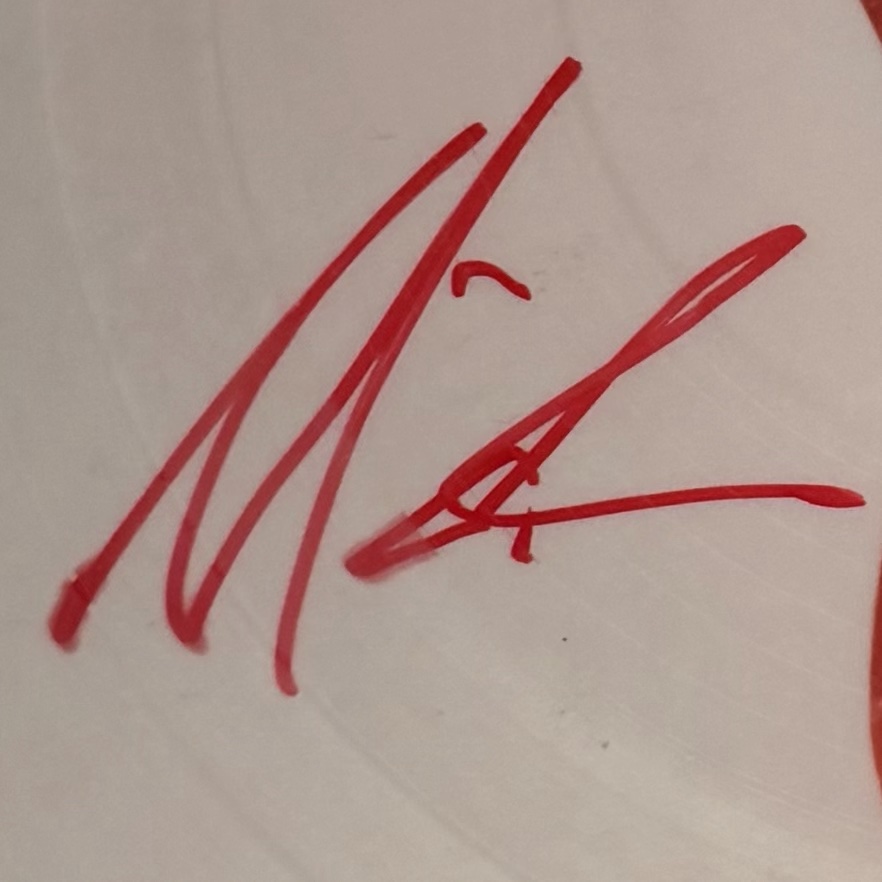
Fig. Q
Red marker on vinyl
Signed picture disc (vinyl) · red marker · lacquered surface.
- Colour changes; the required components — peaks, lean, exit stroke — are the diagnostic, not the ink.
- Signed on vinyl, like Figs. F and G — compare Fig. G, a certified red paint-pen picture disc.
In-person signature obtained by a fan and shared publicly. Unauthenticated by a major TPA — screening plate only.
Source: Fan photograph, shared publicly online; used with credit for collector education.
Photograph credit: Lambily. If this is your photo and you'd like your own name here instead, or would like it removed, please reach out.
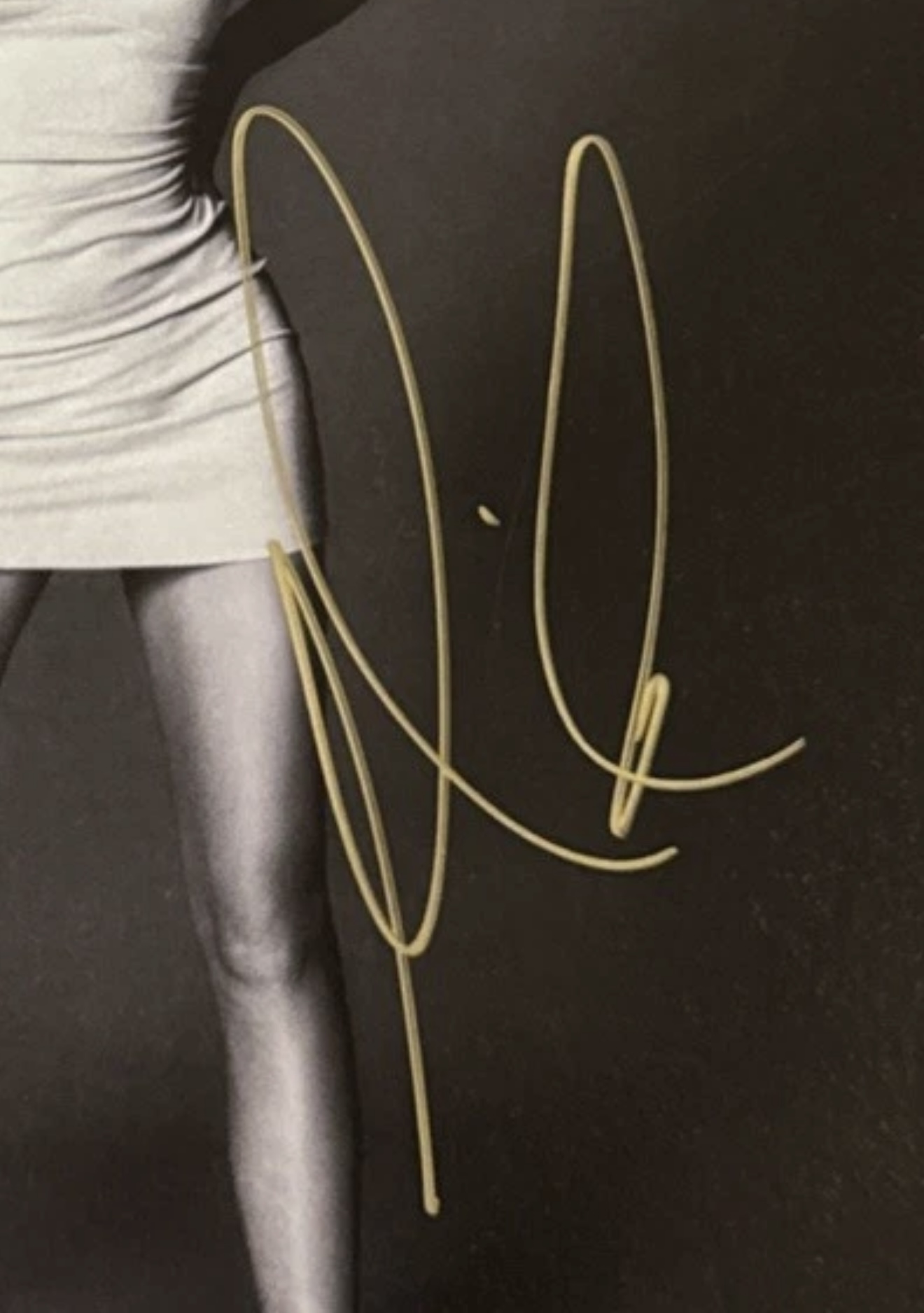
Fig. R
Metallic marker on a printed photograph
Signed photograph · gold or metallic marker · photographic print.
- Metallic ink sits visibly on top of the printed surface rather than absorbing into it.
- Shown for ink variety; no signing date is claimed.
In-person signature obtained by a fan and shared publicly. Unauthenticated by a major TPA — screening plate only.
Source: Fan photograph, shared publicly online; used with credit for collector education.
Photograph credit: Lambily. If this is your photo and you'd like your own name here instead, or would like it removed, please reach out.
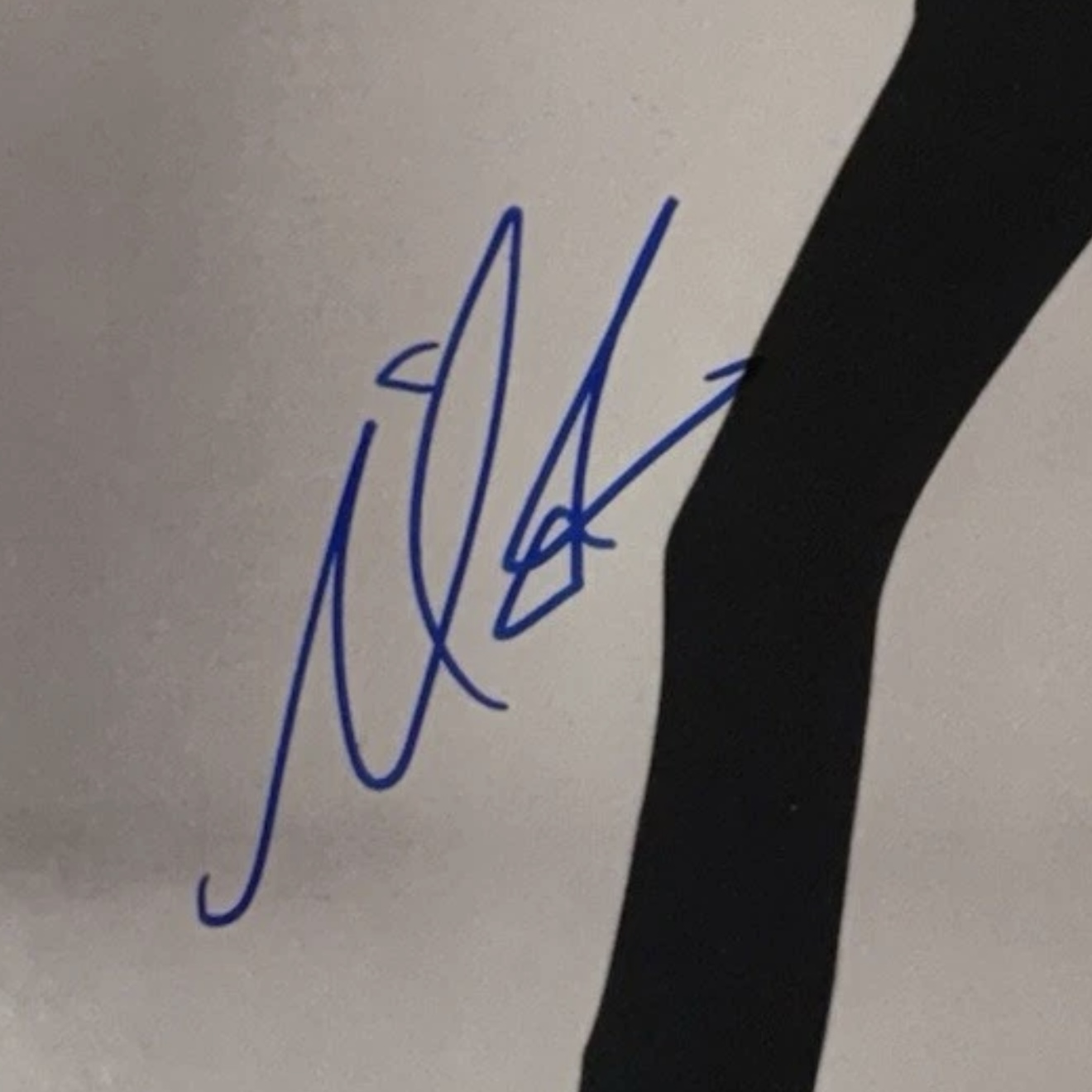
Fig. S
Blue dye marker on a printed photograph
Signed photograph · blue dye marker · coated photographic stock.
- The printed image reads faintly through parts of the stroke, consistent with a dye rather than a paint pen.
- Width narrows through the faster sweeps of the name.
In-person signature obtained by a fan and shared publicly. Unauthenticated by a major TPA — screening plate only.
Source: Fan photograph, shared publicly online; used with credit for collector education.
Photograph credit: Lambily. If this is your photo and you'd like your own name here instead, or would like it removed, please reach out.
§7 Spotting a fake, ranked
Tier one — structural; survives poor photography
- Missing trailing exit stroke on the abbreviated name — the most consistently absent feature on failed items examined for this guide.
- Rounded loops where the genuine form has sharp pointed peaks. Broad tips soften peaks; they do not convert them into loops.
- Upright or vertical axis instead of the pronounced rightward lean.
- Inscription proportions wrong — “ove” too large relative to the L.
Tier two — needs decent photographs
Blunt rounded stops over tapers; uniform stroke width; hesitation, tremor, retouch or double start; stroke-width ratio far outside the normal band.
Tier three — context
Era mismatch between claimed date and visible form; provenance that corroborates an event rather than the item; volume sellers at extreme multiples over unsigned base value; any seller with a documented history of items failing authentication.
The counterintuitive rule
A signature that matches published certified exemplars very closely is not reassurance when it comes from a compromised source. Lookup pages are public. A tight match to a widely circulated certified example is the predicted output of a competent copyist.
Comparisons must be like for like: same period, same signing mode (quick vs full), letter by letter against examples known to be authentic. Collecting random web images is how bad reference material propagates.
§8 Mechanical reproduction
- Preprinted signatures on label or fan-club photos: halftone dots, uniform width, no ink relief, identical position across copies. Honest when sold as prints; a problem when later listed as hand-signed.
- Digitally added signatures: often masked to sit only on background, or they stop at a contour instead of crossing the image. Check two separately lit photographs — real ink keeps the same streak and speckle pattern.
- Autopen: mechanically consistent starts and stops, even weight, specimens that overlay exactly. Human signatures never overlay precisely.
- Secretarial signatures: documented across entertainment; this guide has no verified Mariah secretarial specimens and no published documentation of the practice in her case. Absence is not proof it never happened. Treat mail-in and fan-club sourced items with extra caution.
Plate · printed control
Fig. K
Printed graphic control
Japanese promotional poster · printed white script · coated poster stock.
- Printed design, not hand ink: halftone or flat-ink edge, uniform width, no relief.
- Identical position on every copy of the poster.
Control plate. Printed design, not hand ink.
Source: Curator-supplied reference file.
§9 Provenance
Working hierarchy, strongest first. A reputable specialist authenticator’s opinion; then major TPA supported by provenance; then certification with a full letter; then a sticker alone. Below that, uncertified — price it that way.
Four principles from the guide:
- A genuine ticket stub, fan-club card, or period photo proves the event, not that this object was signed there.
- Obscure, specific provenance is harder to fabricate than a famous public date anyone can look up.
- A charity-auction certificate is chain of custody, not a forensic opinion. The description must name the object in front of you.
- A seller’s story is the variable. Prior authentication failures from that source are the constant.
Plates · paperwork
Fig. L
JSA letter control
JSA letter of authenticity · printed document.
- Shows what a full JSA letter looks like: number, description, image of the item.
- A paperwork plate only. It teaches the document, not the stroke.
- The number must resolve on the authenticator’s own site and describe the object in front of you.
JSA letter · certification YY88876 · verify at JSA official verification ↗
Source: Curator-supplied reference file.
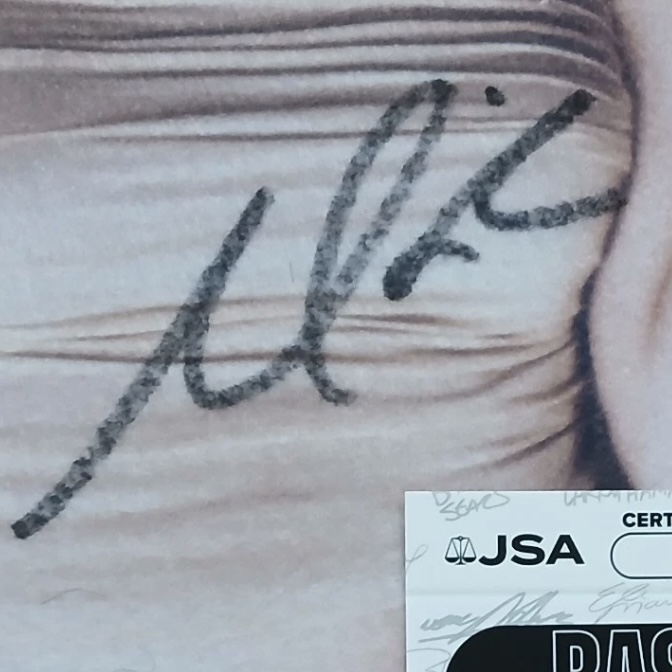
Fig. T
A JSA card in the frame
Signed photograph, framed with a JSA card · marker · photographic print.
- A JSA card is visible in the frame. Its certificate number could not be read reliably from this photograph and is not claimed here.
- Compare Fig. L for a full JSA letter of authenticity, and always verify a number on JSA’s own site before trusting it.
In-person signature obtained by a fan and shared publicly. Unauthenticated by a major TPA — screening plate only.
Source: Fan photograph, shared publicly online; used with credit for collector education.
Photograph credit: Lambily. If this is your photo and you'd like your own name here instead, or would like it removed, please reach out.
§10 What this guide cannot tell you
Named things this guide cannot tell you. The list is printed as written; it is not filled in.
- Detailed characterization of the signature between 1992 and 1999
- The precise year the abbreviated form emerged
- Anything about pen pressure from photographs
- Ballpoint behavior
- Fabric and garment signatures
- Whether secretarial signing occurred, and if so what it looked like
§11 Before you buy checklist
- Ask for a straight-on, in-focus photograph of the signature under normal light, out of any sleeve or case.
- Ask specifically when it was signed. Vague answers are answers.
- Check Tier One: exit stroke, pointed peaks, rightward lean, inscription proportions.
- Confirm the signature appears consistently across at least two differently lit photographs.
- Establish the unsigned value of the object. That number anchors everything else.
- If there is no third-party certification, treat the price as speculative and offer accordingly.
- Check whether the seller has volume signed inventory. If so, cap your confidence.
- For anything above a modest sum, pay for a signature review before buying rather than after.
§12 Sources
Period claims in the evolution section are drawn from auction-house catalogue records for items pre-certified by PSA/DNA, Beckett, and REAL, including material from a long-running in-person collection assembled in the New York metropolitan area beginning in the 1980s. Letterform observations come from direct examination of certified exemplars and of items that later failed third-party review.
Plates in this guide: 20 figures. Figs. A–L are reserved for Sanctuary or curator-supplied files with a known object and, where stated, a certificate. The supplementary plates (Fig. M onward, plus the photographs in Figs. E and J) are in-person signatures obtained by fans and shared publicly online. The Sanctuary does not own those objects and claims nothing about them beyond what the photograph shows. They are gathered here for one reason: so that fans can compare a resale listing against real, fan-obtained examples before spending money. Every fan photograph is credited once the poster is confirmed, and any poster may ask to be named or to have the photograph removed. Auction houses are cited under the relevant plate rather than copied.
§13 Contributing
Certified, dated examples from 1992–2004, and certified ballpoint or fabric examples, would close named gaps. If you hold one and can share a straight-on photograph with its certificate number, the Sanctuary would like to see it. Contributions are credited only with permission and are never listed for sale.